Treatment duration
Simple removal may take 15–45 minutes. Multiple, large or surgically excised lesions take longer.
Diagnosis before cosmetic removal
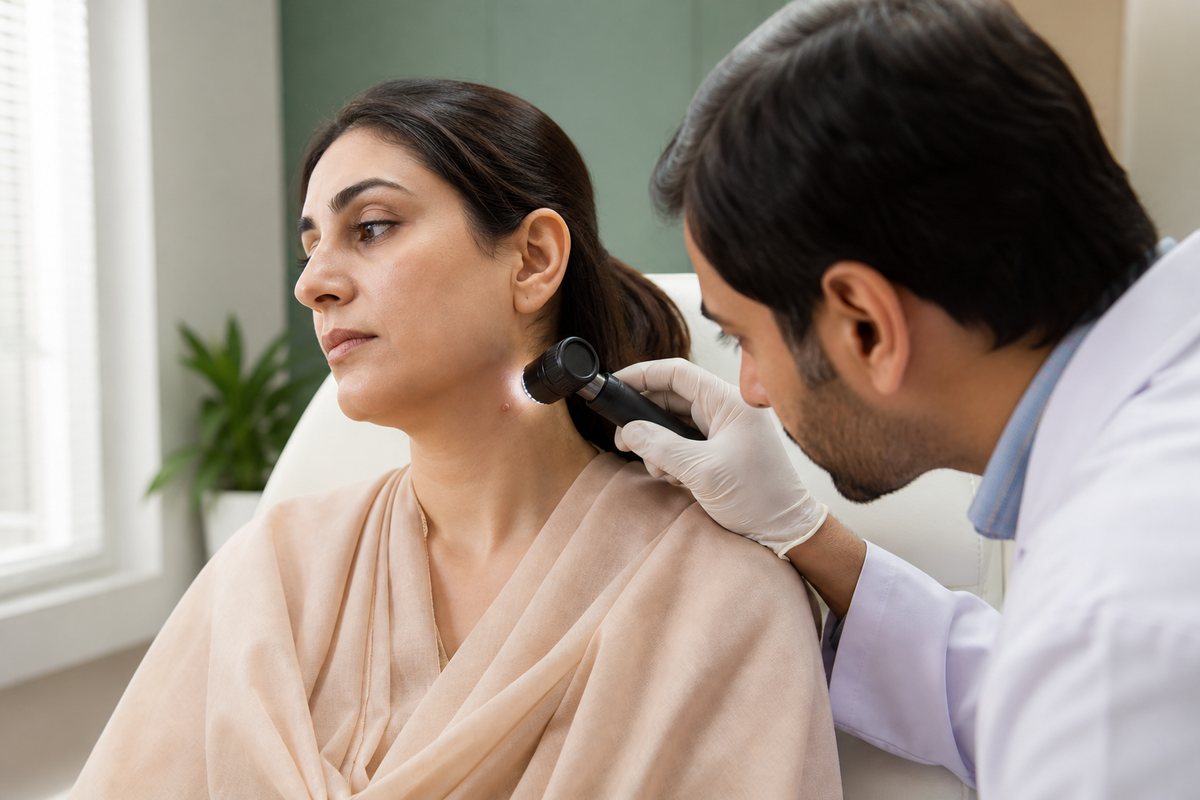
Skin tags, moles and warts are different lesions and should not automatically receive the same laser or cautery treatment. Diagnosis comes first, especially for a new, changing, irregular, bleeding or repeatedly crusting lesion.
Treatment explained
A clinician examines the lesion and decides whether it appears suitable for simple removal, needs dermoscopic review, should be sampled for pathology or requires referral. Removal methods include snip or shave excision, full excision, curettage, freezing, cautery or selected laser treatment.
Problems and conditions
Possible suitability
Safety screening
This list is not exhaustive. The treating clinician must confirm contraindications and any condition-specific precautions.
Individual assessment
The clinician records duration, change, symptoms, sun history, personal or family skin-cancer history, medicines, keloids and healing. Photography or dermoscopy may be used. Any uncertain lesion should be managed diagnostically rather than destroyed without tissue.
Step-by-step overview
Simple removal may take 15–45 minutes. Multiple, large or surgically excised lesions take longer.
Tiny skin tags may need none or topical numbing. Shave or full excision commonly uses injected local anaesthetic.
The exact technique, setting and anaesthetic plan require confirmation from the treating clinician after examination.
Downtime and healing
A small scab, dressing or stitches may be present.
The clinician gives a specific date when non-dissolving sutures are used.
Colour and firmness continue changing after the wound closes.
The lesion can often be removed, but recurrence or new lesions are possible. Every removal leaves some form of mark; scar size depends on lesion and method.
Recovery and result timing are general ranges, not guarantees. Your written instructions and review findings take priority.
Potential benefits
Informed consent
Before treatment
After treatment
Why choose Dr Husnain Aesthetic Clinic?
Care is led by Assoc. Prof. Dr Husnain Khan, MBBS, MCPS, FCPS, MRCS, plastic and cosmetic surgeon. He has more than 17 years of experience, is Head of the Department of Plastic Surgery at Holy Family Hospital, Rawalpindi, has worked in the UK NHS and is listed with GMC reference 7427786.
These credentials do not guarantee an outcome. The purpose of consultation is to decide whether treatment is reasonable for you and explain alternatives, limitations and follow-up.
Clinic-supplied procedure rates
These are the clinic-supplied rate-list values. Confirm the current rate and exactly what it includes before booking. Your final written quotation may differ according to the assessed procedure scope, facility, anaesthesia, tests, medicines and follow-up.
View the complete procedure price list →Personalised quotation
A responsible quotation follows consultation because price depends on the treatment plan rather than the page name alone. Relevant factors include:
The published rate-list value is not a guaranteed final quotation. Ask what the written quotation includes and whether future sessions, tests, medicines or follow-up are separate.
Read the treatment-cost planning guide →Patient questions
No. A mole needing diagnosis or pathology should not be destroyed by laser. Depth and recurrence also matter.
Yes, every removal leaves a mark. The goal is a well-planned scar, not an impossible scar-free result.
Warts are caused by human papillomavirus and can spread. Treatment may need repetition.
A removed tag may not regrow from the same point, but new tags can develop nearby.
Change in size, shape or colour, irregularity, bleeding, crusting, persistent itch or a new unusual lesion warrants medical assessment.
Not every obvious skin tag requires it, but suspicious or uncertain lesions and many excisions should be considered for histopathology.
Cutting, burning or applying acids can cause bleeding, infection, scarring and delayed diagnosis.
Small wounds often close in one to two weeks, but site, depth, health and method affect healing.
Independent patient information
These external resources support further reading. They do not replace advice from the clinician responsible for your care.
Request a private appointment in Rawalpindi. Patients from Islamabad, elsewhere in Pakistan and overseas can ask what information is needed before travelling.
General patient information · Last reviewed 21 September 2026 · This page does not replace an examination, diagnosis or informed-consent discussion.