Treatment duration
A session often takes 45–90 minutes including topical numbing.
Needling with controlled radiofrequency
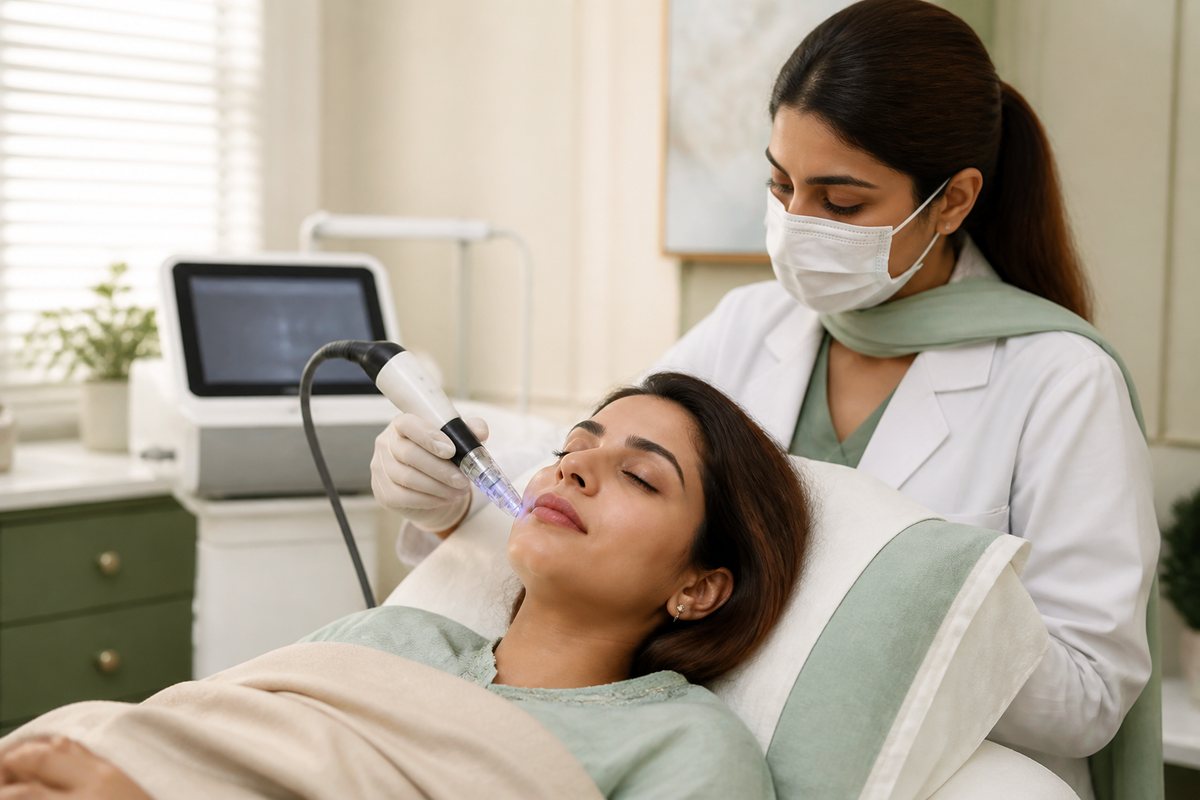
Radiofrequency microneedling places fine needles at a controlled depth and delivers heat within tissue. It may be considered for selected acne scars, texture or mild laxity, but device type and settings must be matched to skin and anatomy.
Treatment explained
Unlike standard microneedling, RF microneedling adds thermal energy through the needles. Insulated and non-insulated designs distribute heat differently. Availability of a specific platform must be confirmed with the clinic.
Problems and conditions
Possible suitability
Safety screening
This list is not exhaustive. The treating clinician must confirm contraindications and any condition-specific precautions.
Individual assessment
The clinician reviews the indication, skin type, scar depth, implanted devices, medicines, previous energy treatments and pigment history. Needle depth and energy should vary by area and tissue thickness.
Step-by-step overview
A session often takes 45–90 minutes including topical numbing.
Topical anaesthetic is commonly used. Selected deeper treatment may require additional pain-control planning.
The exact technique, setting and anaesthetic plan require confirmation from the treating clinician after examination.
Downtime and healing
Pinpoint crusting can occur.
Dryness or a grid-like appearance should fade.
Collagen change continues after a planned series.
Some patients notice progressive texture or firmness change after several weeks. Multiple sessions may be proposed, and deep tethered scars or marked laxity need different treatment.
Recovery and result timing are general ranges, not guarantees. Your written instructions and review findings take priority.
Potential benefits
Informed consent
Before treatment
After treatment
Why choose Dr Husnain Aesthetic Clinic?
Care is led by Assoc. Prof. Dr Husnain Khan, MBBS, MCPS, FCPS, MRCS. He has more than 17 years of experience as a plastic surgeon, is Head of the Department of Plastic Surgery at Holy Family Hospital, Rawalpindi, has worked in the UK NHS and is listed with GMC reference 7427786.
These credentials do not guarantee an outcome. The purpose of consultation is to decide whether treatment is reasonable for you and explain alternatives, limitations and follow-up.
Personalised quotation
A responsible quotation follows consultation because price depends on the treatment plan rather than the page name alone. Relevant factors include:
The published rate-list value is not a guaranteed final quotation. Ask what the written quotation includes and whether future sessions, tests, medicines or follow-up are separate.
Read the treatment-cost planning guide →Patient questions
RF microneedling adds controlled heat through the needles; standard microneedling relies mainly on mechanical channels.
They create different patterns of injury. Scar type, skin tone, downtime and pigment risk determine which is more appropriate.
A series is common, but the number depends on indication, settings, response and acceptable downtime.
Excessive depth or energy may affect fat. Careful anatomical settings are important, especially in lean faces.
It can be used in darker skin, but conservative settings and pigment monitoring remain necessary.
Device availability and the cartridge proposed must be confirmed directly with the clinic before booking.
Wait until the surface is intact and the clinician’s aftercare interval has passed.
Improvement is usually partial and progressive. Deep scars or significant laxity may require additional methods.
Independent patient information
These external resources support further reading. They do not replace advice from the clinician responsible for your care.
Request a private appointment in Rawalpindi. Patients from Islamabad, elsewhere in Pakistan and overseas can ask what information is needed before travelling.
General patient information · Last reviewed 12 September 2026 · This page does not replace an examination, diagnosis or informed-consent discussion.