Treatment duration
Sessions commonly take 30–90 minutes depending on area and combination. A course separated by healing intervals is common, but the number is determined after assessment.
Texture and scar remodelling
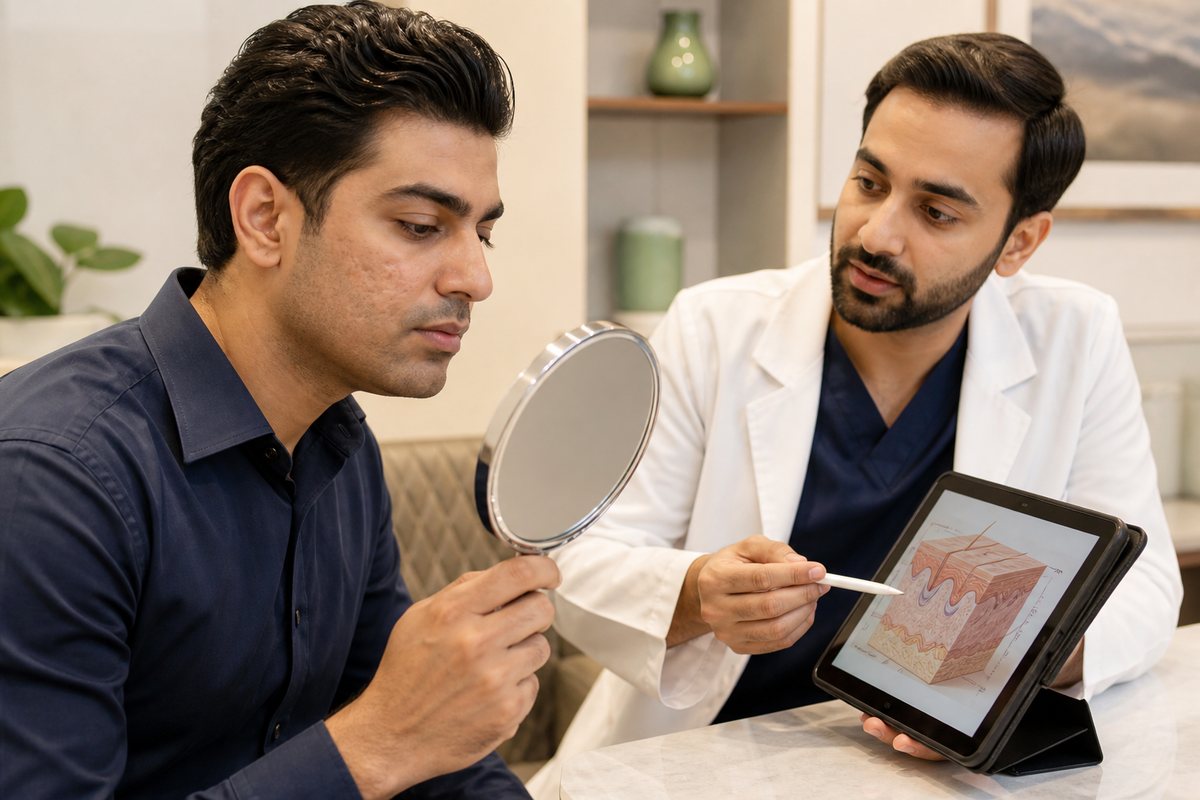
Acne scars are treated according to scar shape, depth, tethering, colour and skin type. Most patients have more than one scar pattern, so a staged combination plan may be more appropriate than one device for the whole face.
Treatment explained
Permanent acne scars form when inflammation damages or overproduces collagen. Depressed scars include ice-pick, rolling and boxcar patterns; raised hypertrophic or keloid scars require a different approach. Flat red or brown marks are discoloration rather than textural scars.
Problems and conditions
Possible suitability
Safety screening
This list is not exhaustive. The treating clinician must confirm contraindications and any condition-specific precautions.
Individual assessment
The face is examined in directional light and, where appropriate, stretched to identify tethering. The clinician records scar types, active acne, pigment tendency, previous isotretinoin or procedures, keloid history and acceptable downtime.
Step-by-step overview
Sessions commonly take 30–90 minutes depending on area and combination. A course separated by healing intervals is common, but the number is determined after assessment.
Topical numbing is common for needling or resurfacing. Subcision, focal excision or deeper work may need injected local anaesthetic.
The exact technique, setting and anaesthetic plan require confirmation from the treating clinician after examination.
Downtime and healing
Downtime varies from mild needling to stronger resurfacing.
Pakistani skin tones need careful sun protection and monitoring for darkening.
Improvement develops between sessions and can continue after the course.
The goal is meaningful softening, not complete erasure. Deep ice-pick or tethered scars often need targeted methods, and residual pigment may require separate treatment.
Recovery and result timing are general ranges, not guarantees. Your written instructions and review findings take priority.
Potential benefits
Informed consent
Before treatment
After treatment
Why choose Dr Husnain Aesthetic Clinic?
Care is led by Assoc. Prof. Dr Husnain Khan, MBBS, MCPS, FCPS, MRCS, plastic and cosmetic surgeon. He has more than 17 years of experience, is Head of the Department of Plastic Surgery at Holy Family Hospital, Rawalpindi, has worked in the UK NHS and is listed with GMC reference 7427786.
These credentials do not guarantee an outcome. The purpose of consultation is to decide whether treatment is reasonable for you and explain alternatives, limitations and follow-up.
Personalised quotation
A responsible quotation follows consultation because price depends on the treatment plan rather than the page name alone. Relevant factors include:
The published rate-list value is not a guaranteed final quotation. Ask what the written quotation includes and whether future sessions, tests, medicines or follow-up are separate.
Read the treatment-cost planning guide →Patient questions
There is no single best method. Scar type, depth, tethering, skin tone, active acne and downtime determine the plan.
Treatment can soften scars, but complete removal is uncommon and should not be guaranteed.
Microneedling generally has less surface injury, while fractional CO2 can provide stronger resurfacing with more downtime and pigment risk. Suitability differs.
Subcision releases selected fibrous bands beneath rolling or tethered scars. It does not treat every scar type.
The number depends on scar pattern, chosen method, response and desired improvement. A fixed number cannot be promised before assessment.
Sometimes, but active inflammation and pigment sensitivity may make a staged plan safer.
Treated scars do not usually return in the same way, but new acne can create new scars and ageing changes skin texture.
Several options can be used, but conservative settings, sun protection and pigment-risk planning are important.
Independent patient information
These external resources support further reading. They do not replace advice from the clinician responsible for your care.
Request a private appointment in Rawalpindi. Patients from Islamabad, elsewhere in Pakistan and overseas can ask what information is needed before travelling.
General patient information · Last reviewed 21 September 2026 · This page does not replace an examination, diagnosis or informed-consent discussion.