
Treatment duration
Small facial areas may take minutes; legs or larger body areas can take 30–90 minutes.
Long-term unwanted-hair reduction
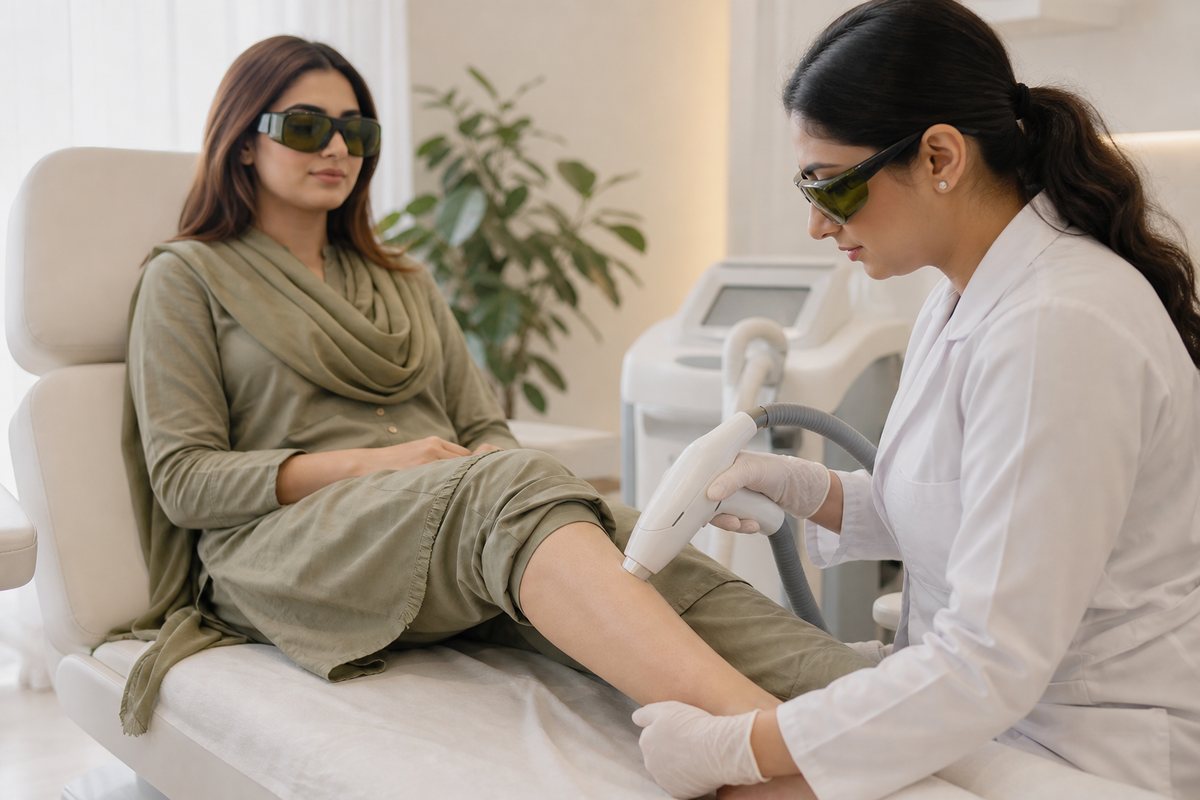
Laser hair removal uses light absorbed by pigment in the hair follicle to reduce future growth. It works best on pigmented coarse hair and requires repeated sessions because follicles cycle through different growth phases.
Treatment explained
A suitable laser or intense pulsed light system delivers controlled energy to selected hair follicles. Wavelength, pulse duration, fluence and cooling must be matched to hair colour, thickness, treatment area and skin tone. Device availability must be confirmed.
Problems and conditions
Possible suitability
Safety screening
This list is not exhaustive. The treating clinician must confirm contraindications and any condition-specific precautions.
Individual assessment
The clinician records skin type, hair colour and calibre, recent tanning, medicines, hormonal symptoms, scarring and prior reactions. A test patch may be appropriate, particularly for darker skin or a new device.
Step-by-step overview
Small facial areas may take minutes; legs or larger body areas can take 30–90 minutes.
Usually none. Cooling reduces discomfort; topical numbing is not automatically appropriate for large areas and must be used safely.
The exact technique, setting and anaesthetic plan require confirmation from the treating clinician after examination.
Downtime and healing
A mild sunburn-like reaction can occur.
Treated hairs release gradually rather than disappearing immediately.
Spacing varies by area and hair cycle.
A course can produce long-term hair reduction, not guaranteed permanent removal of every follicle. Hormonal changes and dormant follicles can cause future growth, and maintenance may be needed.
Recovery and result timing are general ranges, not guarantees. Your written instructions and review findings take priority.
Potential benefits
Informed consent
Before treatment
After treatment
Why choose Dr Husnain Aesthetic Clinic?
Care is led by Assoc. Prof. Dr Husnain Khan, MBBS, MCPS, FCPS, MRCS, plastic and cosmetic surgeon. He has more than 17 years of experience, is Head of the Department of Plastic Surgery at Holy Family Hospital, Rawalpindi, has worked in the UK NHS and is listed with GMC reference 7427786.
These credentials do not guarantee an outcome. The purpose of consultation is to decide whether treatment is reasonable for you and explain alternatives, limitations and follow-up.
Personalised quotation
A responsible quotation follows consultation because price depends on the treatment plan rather than the page name alone. Relevant factors include:
The published rate-list value is not a guaranteed final quotation. Ask what the written quotation includes and whether future sessions, tests, medicines or follow-up are separate.
Read the treatment-cost planning guide →Patient questions
It is better described as long-term hair reduction. Some follicles remain or recover, and maintenance may be needed.
Several sessions are common because only some hairs are in the responsive growth phase at one time. The number varies.
Wavelength and settings matter. Certain long-pulse systems may offer a wider safety margin, but device choice requires skin assessment.
These hairs contain little melanin and usually respond poorly to pigment-targeting lasers.
Usually yes, according to clinic instructions. Waxing or plucking removes the follicular target and is generally avoided.
Yes. New or increasing coarse hair may justify medical assessment in addition to cosmetic reduction.
Patients often describe brief heat or snapping sensations. Cooling and appropriate settings improve tolerance.
Paradoxical growth is uncommon but reported, particularly in some facial and neck areas. This should be discussed.
Independent patient information
These external resources support further reading. They do not replace advice from the clinician responsible for your care.
Request a private appointment in Rawalpindi. Patients from Islamabad, elsewhere in Pakistan and overseas can ask what information is needed before travelling.
General patient information · Last reviewed 21 September 2026 · This page does not replace an examination, diagnosis or informed-consent discussion.