Treatment duration
Consultation often takes 20–40 minutes. Procedures may take 20–60 minutes. Several weeks to months are usually needed to judge pigment change.
Dark marks and uneven tone
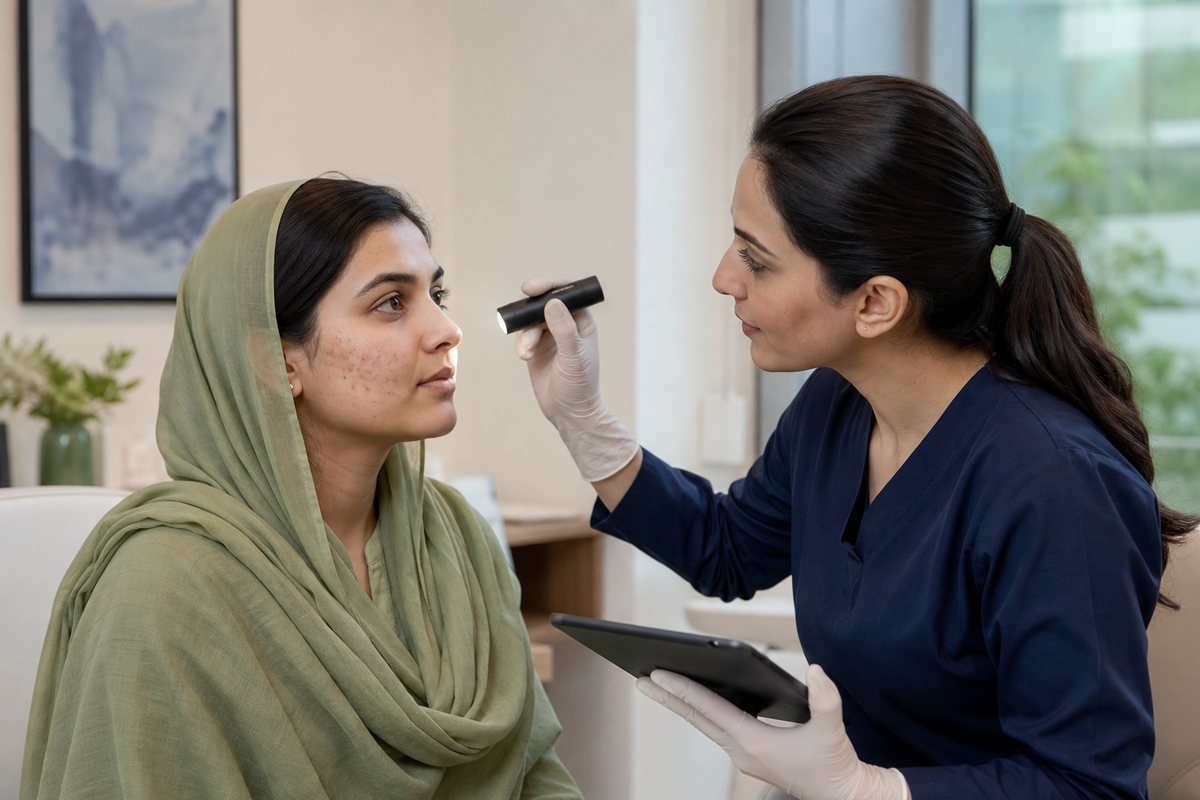
Hyperpigmentation is a description, not one diagnosis. Dark marks can follow acne, eczema, friction or injury, while freckles, sun spots and melasma have different patterns and treatment responses.
Treatment explained
Hyperpigmentation occurs when skin produces or retains excess melanin. Treatment begins by identifying the cause and depth, controlling ongoing inflammation and protecting from ultraviolet and visible light.
Problems and conditions
Possible suitability
Safety screening
This list is not exhaustive. The treating clinician must confirm contraindications and any condition-specific precautions.
Individual assessment
Assessment reviews the start and pattern of pigment, preceding inflammation, products, medicines, hormones, friction and sun exposure. A lesion that may be medically significant is assessed or referred rather than cosmetically treated.
Step-by-step overview
Consultation often takes 20–40 minutes. Procedures may take 20–60 minutes. Several weeks to months are usually needed to judge pigment change.
Topical plans and many light peels need none. Cooling or topical numbing may be used for selected devices.
The exact technique, setting and anaesthetic plan require confirmation from the treating clinician after examination.
Downtime and healing
Dryness or irritation can occur during adjustment.
Redness, darkening or light peeling may occur depending on treatment.
Deeper or recurrent pigment can take longer and may need maintenance.
Improvement depends on the diagnosis, pigment depth, trigger control and sun protection. Pigment can recur, and aggressive treatment can make it darker.
Recovery and result timing are general ranges, not guarantees. Your written instructions and review findings take priority.
Potential benefits
Informed consent
Before treatment
After treatment
Why choose Dr Husnain Aesthetic Clinic?
Care is led by Assoc. Prof. Dr Husnain Khan, MBBS, MCPS, FCPS, MRCS. He has more than 17 years of experience as a plastic surgeon, is Head of the Department of Plastic Surgery at Holy Family Hospital, Rawalpindi, has worked in the UK NHS and is listed with GMC reference 7427786.
These credentials do not guarantee an outcome. The purpose of consultation is to decide whether treatment is reasonable for you and explain alternatives, limitations and follow-up.
Personalised quotation
A responsible quotation follows consultation because price depends on the treatment plan rather than the page name alone. Relevant factors include:
The published rate-list value is not a guaranteed final quotation. Ask what the written quotation includes and whether future sessions, tests, medicines or follow-up are separate.
Read the treatment-cost planning guide →Patient questions
No. Melasma is one specific recurrent pigment disorder; hyperpigmentation also includes marks after acne, injury or inflammation.
Some fade substantially while others persist or recur. Results depend on cause, depth and prevention of new inflammation.
Inflammation can stimulate melanin production. Darker skin tones may retain post-inflammatory pigment for longer.
Safety depends on ingredients, strength and supervision. Unlabelled products may contain harmful steroids or mercury.
No single laser treats every pigment condition, and inappropriate settings can worsen darkening.
The cause may include friction, dermatitis, products or a medical condition. Assessment is more useful than immediate bleaching.
Visible light through windows and incidental exposure may matter for some pigment disorders. Your clinician can recommend suitable protection.
Seek assessment for a new or changing spot, irregular borders or colours, bleeding, crusting, pain or rapid growth.
Independent patient information
These external resources support further reading. They do not replace advice from the clinician responsible for your care.
Request a private appointment in Rawalpindi. Patients from Islamabad, elsewhere in Pakistan and overseas can ask what information is needed before travelling.
General patient information · Last reviewed 12 September 2026 · This page does not replace an examination, diagnosis or informed-consent discussion.