Treatment duration
Injection visits often take 15–30 minutes and are repeated at planned intervals. Surgery time depends on site and reconstruction.
Raised scar assessment and control
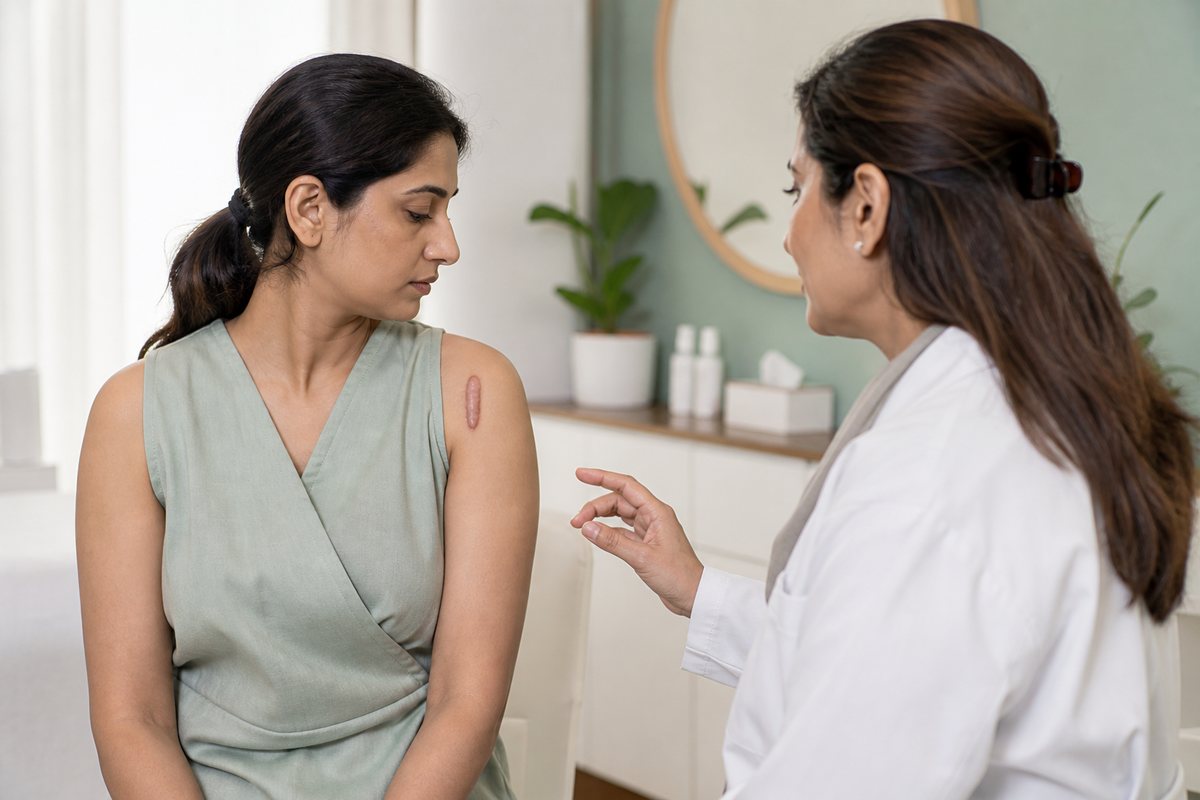
A keloid is a raised scar that grows beyond the original wound boundary. Treatment can flatten, soften or reduce symptoms, but recurrence is common—especially when excision is used without an appropriate combined plan.
Treatment explained
Options include silicone, pressure, corticosteroid or other selected injections, cryotherapy, laser and surgery with adjuvant treatment. The site, size, symptoms, previous recurrence and skin type guide the sequence.
Problems and conditions
Possible suitability
Safety screening
This list is not exhaustive. The treating clinician must confirm contraindications and any condition-specific precautions.
Individual assessment
Assessment distinguishes keloid from hypertrophic scar and other skin lumps. The clinician records trigger, growth, symptoms, site, prior injections or excision, family history and response.
Step-by-step overview
Injection visits often take 15–30 minutes and are repeated at planned intervals. Surgery time depends on site and reconstruction.
Injections can be painful; local anaesthetic may be used. Surgical excision uses local or general anaesthesia depending on size and site.
The exact technique, setting and anaesthetic plan require confirmation from the treating clinician after examination.
Downtime and healing
Tenderness, swelling or colour change may occur.
Wound care and pressure planning are site-dependent.
Keloids can regrow months after apparent healing.
Treatment may reduce height, firmness, itch or pain. Complete and permanent clearance cannot be guaranteed; recurrence is a central part of consent.
Recovery and result timing are general ranges, not guarantees. Your written instructions and review findings take priority.
Potential benefits
Informed consent
Before treatment
After treatment
Why choose Dr Husnain Aesthetic Clinic?
Care is led by Assoc. Prof. Dr Husnain Khan, MBBS, MCPS, FCPS, MRCS. He has more than 17 years of experience as a plastic surgeon, is Head of the Department of Plastic Surgery at Holy Family Hospital, Rawalpindi, has worked in the UK NHS and is listed with GMC reference 7427786.
These credentials do not guarantee an outcome. The purpose of consultation is to decide whether treatment is reasonable for you and explain alternatives, limitations and follow-up.
Clinic-supplied procedure rates
These are the clinic-supplied rate-list values. Confirm the current rate and exactly what it includes before booking. Your final written quotation may differ according to the assessed procedure scope, facility, anaesthesia, tests, medicines and follow-up.
View the complete procedure price list →Personalised quotation
A responsible quotation follows consultation because price depends on the treatment plan rather than the page name alone. Relevant factors include:
The published rate-list value is not a guaranteed final quotation. Ask what the written quotation includes and whether future sessions, tests, medicines or follow-up are separate.
Read the treatment-cost planning guide →Patient questions
A keloid extends beyond the original wound; a hypertrophic scar remains within its boundaries.
Recurrence is common, so permanent cure cannot be promised.
They can soften and flatten selected keloids over a series but can cause skin thinning and pigment change.
Excision alone can trigger a larger recurrence. A combined postoperative plan is usually considered.
Their shape can allow pressure devices and surgery, but recurrence still occurs.
The number depends on size, firmness, site, response and side effects.
Yes. People with keloid tendency should discuss avoiding new piercings or elective skin trauma.
Follow the planned schedule and seek earlier review if rapid regrowth, ulceration, discharge or increasing pain occurs.
Independent patient information
These external resources support further reading. They do not replace advice from the clinician responsible for your care.
Request a private appointment in Rawalpindi. Patients from Islamabad, elsewhere in Pakistan and overseas can ask what information is needed before travelling.
General patient information · Last reviewed 12 September 2026 · This page does not replace an examination, diagnosis or informed-consent discussion.