Treatment duration
Filler often takes 30–60 minutes. Fat grafting or implants commonly take 1–3 hours depending on anaesthesia and combined procedures.
Midface volume and structure
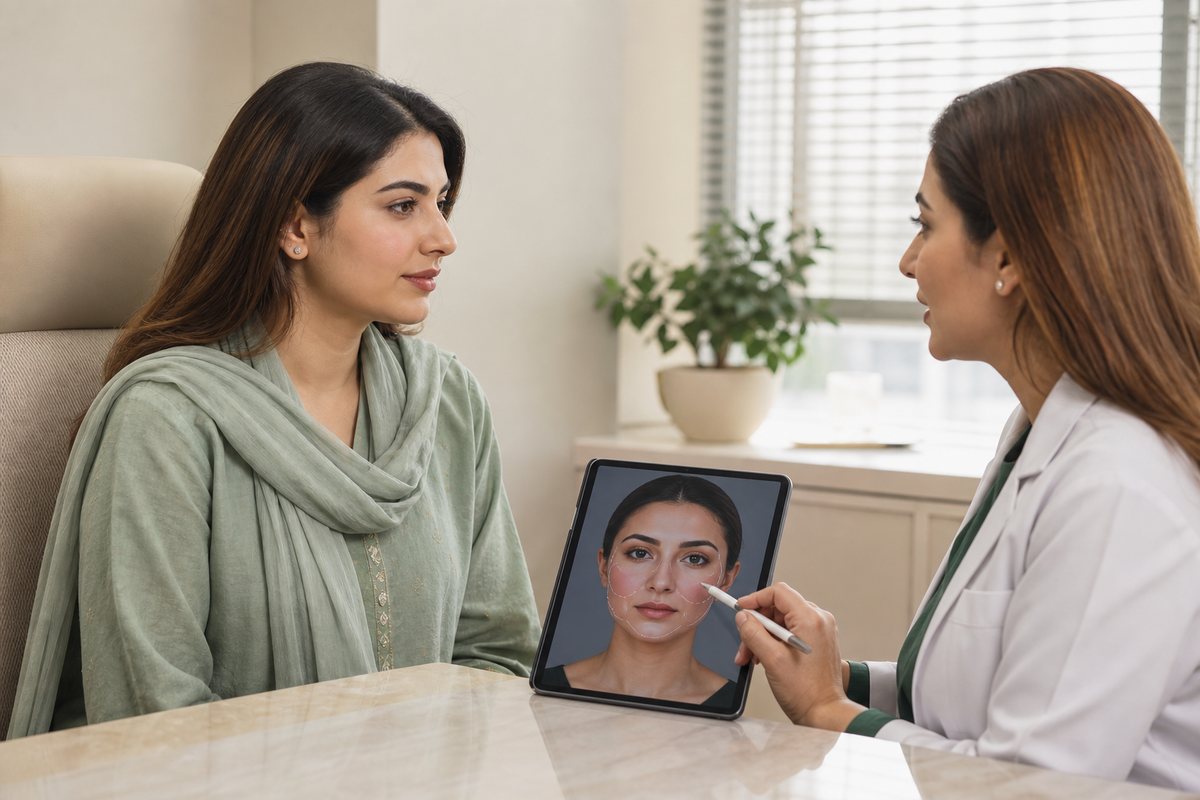
Cheek augmentation can use temporary filler, a patient’s own fat or a surgical implant. The appropriate option depends on skeletal projection, soft-tissue volume, skin laxity, desired duration and tolerance for surgery.
Treatment explained
Filler adds an injectable material, fat grafting transfers living fat cells and an implant adds a fixed structural shape over the cheekbone. These methods have different predictability, recovery and complication profiles.
Problems and conditions
Possible suitability
Safety screening
This list is not exhaustive. The treating clinician must confirm contraindications and any condition-specific precautions.
Individual assessment
Assessment reviews cheekbone projection, facial width, lower-eyelid support, soft-tissue volume, asymmetry, prior filler and skin laxity. Temporary filler may not predict the exact appearance of an implant.
Step-by-step overview
Filler often takes 30–60 minutes. Fat grafting or implants commonly take 1–3 hours depending on anaesthesia and combined procedures.
Filler uses topical or local anaesthesia. Fat transfer or implants may use local anaesthesia with sedation or general anaesthesia.
The exact technique, setting and anaesthetic plan require confirmation from the treating clinician after examination.
Downtime and healing
Bruising and asymmetry can be temporary.
Implants or fat grafting cause more swelling.
Fat retention, implant tissues and scars mature gradually.
Filler is temporary, fat retention is variable and implants are long-lasting but not immune to ageing or later revision. Exact symmetry and duration cannot be guaranteed.
Recovery and result timing are general ranges, not guarantees. Your written instructions and review findings take priority.
Potential benefits
Informed consent
Before treatment
After treatment
Why choose Dr Husnain Aesthetic Clinic?
Care is led by Assoc. Prof. Dr Husnain Khan, MBBS, MCPS, FCPS, MRCS. He has more than 17 years of experience as a plastic surgeon, is Head of the Department of Plastic Surgery at Holy Family Hospital, Rawalpindi, has worked in the UK NHS and is listed with GMC reference 7427786.
These credentials do not guarantee an outcome. The purpose of consultation is to decide whether treatment is reasonable for you and explain alternatives, limitations and follow-up.
Personalised quotation
A responsible quotation follows consultation because price depends on the treatment plan rather than the page name alone. Relevant factors include:
The published rate-list value is not a guaranteed final quotation. Ask what the written quotation includes and whether future sessions, tests, medicines or follow-up are separate.
Read the treatment-cost planning guide →Patient questions
Filler is temporary and less invasive; an implant offers fixed surgical projection. The best option depends on anatomy and goals.
Duration varies by product, dose, area and metabolism and cannot be guaranteed.
Some retained fat can be long-lasting, but a variable portion is reabsorbed and weight change affects it.
Added midface volume may change balance but does not remove lower-face skin or replace a facelift.
Movement or malposition is a possible complication and may require revision.
Lateral cheek augmentation can increase perceived width; vector and volume must fit the face.
Many hyaluronic-acid fillers can be treated with hyaluronidase, with limitations and risks.
Compare desired duration, reversibility, donor fat, skeletal need, anaesthesia and complication profile during consultation.
Independent patient information
These external resources support further reading. They do not replace advice from the clinician responsible for your care.
Request a private appointment in Rawalpindi. Patients from Islamabad, elsewhere in Pakistan and overseas can ask what information is needed before travelling.
General patient information · Last reviewed 12 September 2026 · This page does not replace an examination, diagnosis or informed-consent discussion.