
Procedure duration
Implant augmentation often takes 1–2 hours. Sliding genioplasty or combined surgery takes longer.
Facial profile balance
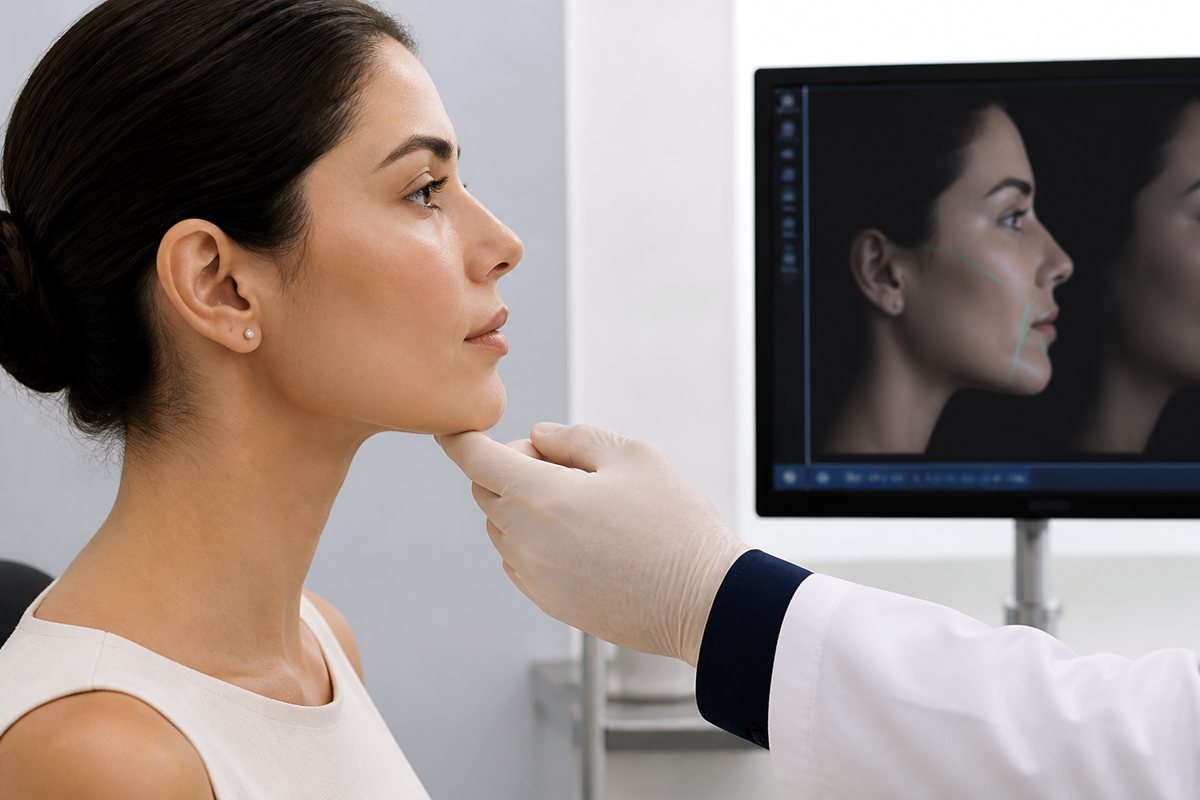
Improve chin projection and facial harmony with a carefully planned surgical approach.
Clear overview
Chin augmentation aims to improve projection or contour of the chin so it sits more harmoniously with the nose, lips and jawline. Options may include an implant, bone surgery or—in selected situations—a non-surgical approach; these are not interchangeable.
Problems and conditions
Possible suitability
Safety screening
This list is not exhaustive. Suitability and contraindications require confirmation by the treating clinician.
Individual decision-making
The consultation evaluates bite, jaw position, soft-tissue thickness and the whole facial profile. If the concern comes from jaw alignment rather than chin projection alone, Dr Husnain may recommend further assessment instead of a simple implant.
Step-by-step overview
The exact technique, anaesthesia and setting depend on your examination and agreed treatment plan. A typical procedure may include:
Implant augmentation often takes 1–2 hours. Sliding genioplasty or combined surgery takes longer.
Local anaesthetic with sedation or general anaesthesia may be used, depending on method and facility.
This overview is educational, not a personalised operative plan. Your consultation and consent discussion will explain the technique proposed for you.
After your procedure
Swelling and tightness around the chin are expected initially. Diet, oral care and activity instructions depend on the surgical route. The contour becomes clearer as swelling settles and tissues adapt.
Swelling, tightness and early bruising usually improve progressively.
The timing depends on the incision and augmentation method.
The tissues adapt and the chin outline becomes clearer.
These are general planning ranges, not a personal clearance date. Recovery differs between patients, and your written instructions and Dr Husnain’s advice take priority over general information online.
Result development
Projection appears immediately but swelling alters the early profile. Implant or bone changes are long-lasting, while the face continues to age.
Potential benefits
Informed consent
Every procedure has limitations and possible complications. Relevant considerations include:
Before treatment
After treatment
Why choose Dr Husnain Aesthetic Clinic?
Care is led by Assoc. Prof. Dr Husnain Khan, MBBS, MCPS, FCPS, MRCS. He has more than 17 years of experience as a plastic surgeon, is Head of the Department of Plastic Surgery at Holy Family Hospital, Rawalpindi, has worked in the UK NHS and is listed with GMC reference 7427786.
Credentials do not guarantee an outcome. Consultation is used to explain realistic options, limitations, recovery and follow-up.
Personalised quotation
Price depends on the individual treatment plan. Factors may include:
The published rate-list value is not a guaranteed final quotation. Ask what is included in writing and whether tests, medicines, facility costs or follow-up are separate.
Read the treatment-cost planning guide →Direct answers
No. Chin augmentation changes chin projection; jaw surgery changes the position of one or both jaws and may address bite or function.
They can be considered together when profile balance is the main concern, but each procedure needs its own assessment and risk discussion.
It can demonstrate temporary added volume, but filler shape and tissue behaviour do not exactly reproduce an implant.
It may be beneath the chin or inside the mouth, depending on technique.
Movement or malposition is a possible complication and may require revision.
A properly planned implant sits outside the jawbone, but dental roots, nerves and bone anatomy are considered.
It moves a segment of the patient’s chin bone and can change projection or vertical position without an implant.
It may improve selected asymmetry, but complex skeletal differences can remain.
Independent patient information
These external resources support further reading. They do not replace advice from the clinician responsible for your care.
Book a private consultation in Satellite Town, Rawalpindi for individual assessment, alternatives, costs, recovery and aftercare guidance. We welcome patients from Rawalpindi, Islamabad and surrounding areas.
General patient information · Last reviewed 12 September 2026 · This page does not replace a medical consultation.