Procedure duration
FUT often takes 5–9 hours depending on graft count and recipient complexity.
Strip-method hair restoration
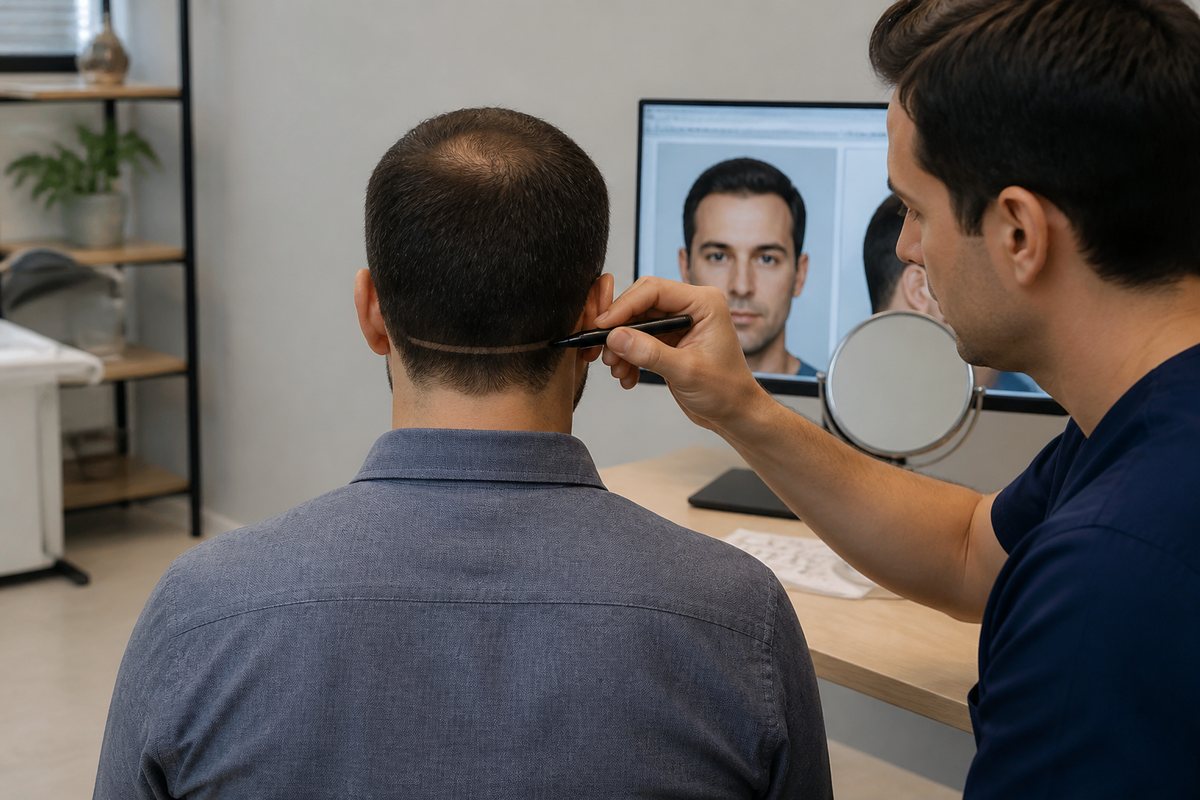
A proven hair-restoration method suited to patients who need broader coverage and lasting density.
Clear overview
Follicular Unit Transplantation removes a narrow strip of hair-bearing scalp from the donor area. The strip is divided into follicular units for placement in thinning areas, while the donor wound is closed to leave a linear scar.
Problems and conditions
Possible suitability
Safety screening
This list is not exhaustive. Suitability and contraindications require confirmation by the treating clinician.
Individual decision-making
Assessment maps the pattern and likely progression of hair loss, donor density, scalp laxity, hair calibre and medical causes of shedding. Hairline design must remain appropriate as natural hair loss continues.
Step-by-step overview
The exact technique, anaesthesia and setting depend on your examination and agreed treatment plan. A typical procedure may include:
FUT often takes 5–9 hours depending on graft count and recipient complexity.
Local anaesthetic injections numb donor and recipient scalp; oral or monitored sedation may be considered.
This overview is educational, not a personalised operative plan. Your consultation and consent discussion will explain the technique proposed for you.
After your procedure
The donor incision needs wound care and planned suture or staple management when used. Crusting and redness occur in the recipient area, and transplanted hairs commonly shed before new growth develops over subsequent months.
Recipient crusting settles while the donor incision receives planned wound care.
The linear donor wound may require a slower return than FUE.
Density usually continues improving for roughly 9–12 months or longer.
These are general planning ranges, not a personal clearance date. Recovery differs between patients, and your written instructions and Dr Husnain’s advice take priority over general information online.
Result development
New growth commonly begins around three to four months and density develops for 9–15 months. The donor scar is permanent.
Potential benefits
Informed consent
Every procedure has limitations and possible complications. Relevant considerations include:
Before treatment
After treatment
Why choose Dr Husnain Aesthetic Clinic?
Care is led by Assoc. Prof. Dr Husnain Khan, MBBS, MCPS, FCPS, MRCS. He has more than 17 years of experience as a plastic surgeon, is Head of the Department of Plastic Surgery at Holy Family Hospital, Rawalpindi, has worked in the UK NHS and is listed with GMC reference 7427786.
Credentials do not guarantee an outcome. Consultation is used to explain realistic options, limitations, recovery and follow-up.
Personalised quotation
Price depends on the individual treatment plan. Factors may include:
The published rate-list value is not a guaranteed final quotation. Ask what is included in writing and whether tests, medicines, facility costs or follow-up are separate.
Read the treatment-cost planning guide →Direct answers
FUT obtains grafts from a donor strip and leaves a linear scar; FUE removes follicular units individually and leaves many small extraction marks.
No. Early shedding is common. New growth develops gradually, and density matures over many months.
Scar width varies with scalp tension, closure, healing and genetics and cannot be guaranteed.
The surgeon provides a date, commonly around 10–14 days depending on closure and healing.
Yes. Long-term donor planning may use both methods strategically.
The linear incision can cause more donor tightness or discomfort, though pain varies and is treated.
A very short haircut may reveal the linear scar.
Survival depends on harvesting, dissection, storage, placement and biology; method alone does not guarantee it.
Independent patient information
These external resources support further reading. They do not replace advice from the clinician responsible for your care.
Book a private consultation in Satellite Town, Rawalpindi for individual assessment, alternatives, costs, recovery and aftercare guidance. We welcome patients from Rawalpindi, Islamabad and surrounding areas.
General patient information · Last reviewed 12 September 2026 · This page does not replace a medical consultation.