Treatment duration
Consultation commonly takes 20–40 minutes. Topical plans are reviewed over months. Procedures, if appropriate, may take 20–60 minutes and are spaced to allow pigment recovery.
Recurring facial pigmentation
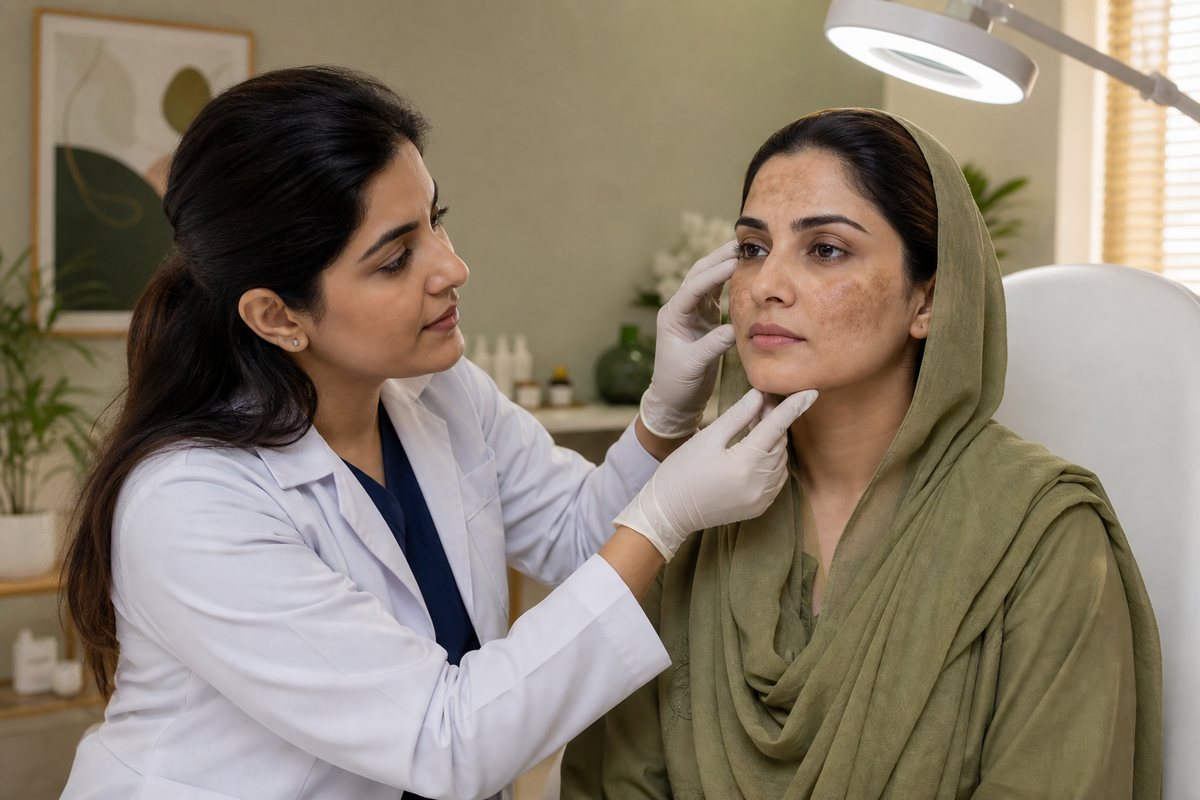
Melasma causes symmetrical brown or grey-brown facial patches and often behaves as a chronic, relapsing pigment condition. Management focuses on identifying triggers, strict light protection and a gradual plan that avoids excessive inflammation.
Treatment explained
Melasma involves increased pigment production influenced by ultraviolet and visible light, hormones, genetics and skin irritation. It commonly affects the cheeks, forehead, upper lip or jawline. A clinical examination helps distinguish it from other pigment disorders.
Problems and conditions
Possible suitability
Safety screening
This list is not exhaustive. The treating clinician must confirm contraindications and any condition-specific precautions.
Individual assessment
Assessment reviews distribution, pregnancy or hormonal associations, medicines, sun exposure, heat, prior peels or lasers and skin sensitivity. Wood-lamp or dermoscopic assessment may support evaluation but does not predict a guaranteed response.
Step-by-step overview
Consultation commonly takes 20–40 minutes. Topical plans are reviewed over months. Procedures, if appropriate, may take 20–60 minutes and are spaced to allow pigment recovery.
Routine assessment and topical care require none. Selected needling, peels or energy-based procedures may use topical numbing or cooling.
The exact technique, setting and anaesthetic plan require confirmation from the treating clinician after examination.
Downtime and healing
Some active products can cause early dryness or irritation.
Redness or peeling depends on the method and intensity.
Pigment change is gradual and maintenance is usually needed.
Melasma can lighten, but recurrence is common with light exposure, hormones or irritation. Maintenance and sun protection are central; a permanent cure should not be promised.
Recovery and result timing are general ranges, not guarantees. Your written instructions and review findings take priority.
Potential benefits
Informed consent
Before treatment
After treatment
Why choose Dr Husnain Aesthetic Clinic?
Care is led by Assoc. Prof. Dr Husnain Khan, MBBS, MCPS, FCPS, MRCS. He has more than 17 years of experience as a plastic surgeon, is Head of the Department of Plastic Surgery at Holy Family Hospital, Rawalpindi, has worked in the UK NHS and is listed with GMC reference 7427786.
These credentials do not guarantee an outcome. The purpose of consultation is to decide whether treatment is reasonable for you and explain alternatives, limitations and follow-up.
Personalised quotation
A responsible quotation follows consultation because price depends on the treatment plan rather than the page name alone. Relevant factors include:
The published rate-list value is not a guaranteed final quotation. Ask what the written quotation includes and whether future sessions, tests, medicines or follow-up are separate.
Read the treatment-cost planning guide →Patient questions
Melasma is often chronic and recurrent. Treatment can lighten it, but maintenance and light protection are usually necessary.
Yes. Consistent broad-spectrum protection and, when advised, visible-light protection are foundational parts of treatment.
It can in some patients, particularly if settings cause inflammation. Lasers are not automatically the first or best option.
Pregnancy and hormonal changes can contribute, but sun, visible light, genetics and irritation also matter.
A fair assessment often takes eight to sixteen weeks, depending on the plan and adherence.
Unapproved skin-lightening injections should not be treated as established melasma care. Ask about evidence, ingredients, regulation and risks.
Light exposure, heat, hormones, irritation and stopping maintenance can contribute to relapse.
Selected superficial peels may support a broader plan, but deeper or aggressive peeling can worsen pigment in susceptible skin.
Independent patient information
These external resources support further reading. They do not replace advice from the clinician responsible for your care.
Request a private appointment in Rawalpindi. Patients from Islamabad, elsewhere in Pakistan and overseas can ask what information is needed before travelling.
General patient information · Last reviewed 12 September 2026 · This page does not replace an examination, diagnosis or informed-consent discussion.