Treatment duration
Treatment often takes 45–90 minutes depending on areas and number of threads.
Temporary suture-based support
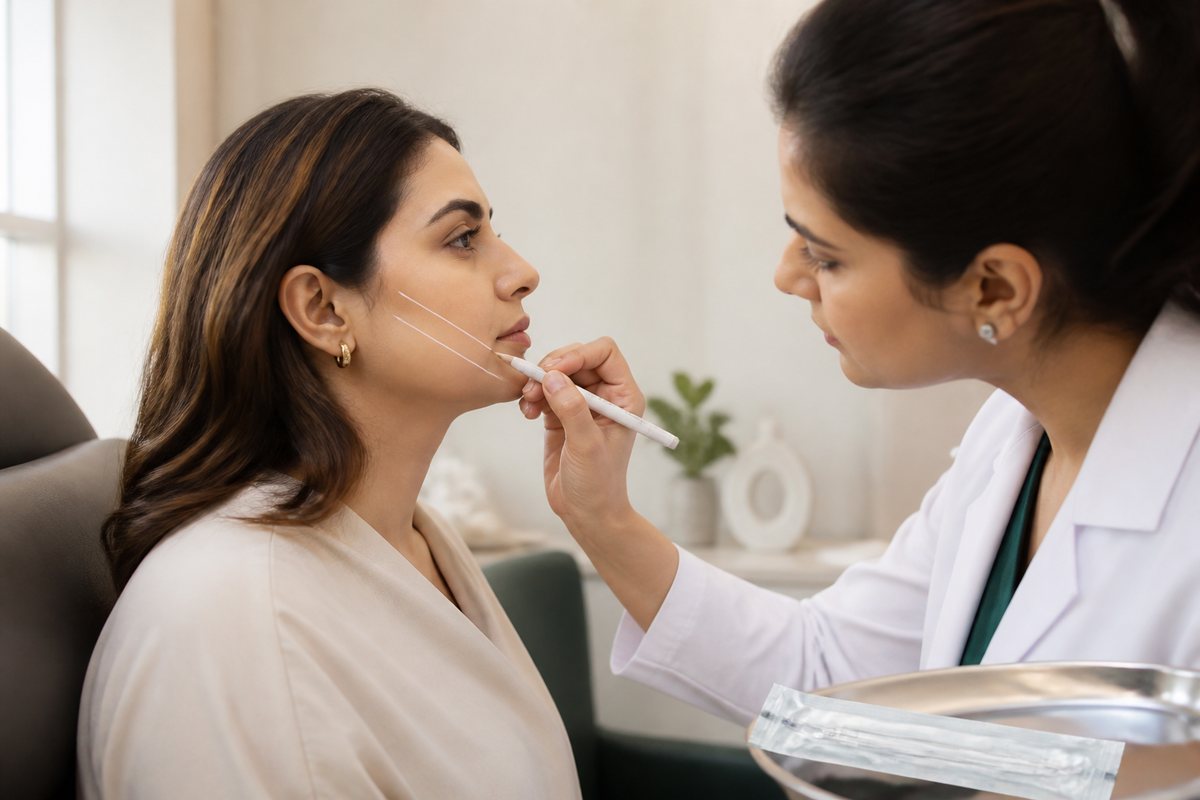
A thread lift places barbed or cone-bearing sutures beneath the skin to create temporary support. It may produce a modest change in selected mild laxity but is not equivalent to facelift surgery.
Treatment explained
Threads are introduced through small needle or cannula access points and positioned in a planned tissue plane. Materials, anchoring and longevity vary. Product availability and authorisation must be confirmed.
Problems and conditions
Possible suitability
Safety screening
This list is not exhaustive. The treating clinician must confirm contraindications and any condition-specific precautions.
Individual assessment
The clinician examines skin thickness, laxity, facial volume, prior filler or threads, scarring, medicines and desired vector. Alternatives include no treatment, energy treatment, filler or facelift.
Step-by-step overview
Treatment often takes 45–90 minutes depending on areas and number of threads.
Injected local anaesthetic is commonly used at entry points and along selected tracks.
The exact technique, setting and anaesthetic plan require confirmation from the treating clinician after examination.
Downtime and healing
Temporary puckering or asymmetry can occur.
Avoid pressure and exaggerated facial movement as instructed.
The lift softens over time and is temporary.
An immediate change may be visible but is affected by swelling and tension. Results are modest and temporary; threads do not remove excess skin.
Recovery and result timing are general ranges, not guarantees. Your written instructions and review findings take priority.
Potential benefits
Informed consent
Before treatment
After treatment
Why choose Dr Husnain Aesthetic Clinic?
Care is led by Assoc. Prof. Dr Husnain Khan, MBBS, MCPS, FCPS, MRCS. He has more than 17 years of experience as a plastic surgeon, is Head of the Department of Plastic Surgery at Holy Family Hospital, Rawalpindi, has worked in the UK NHS and is listed with GMC reference 7427786.
These credentials do not guarantee an outcome. The purpose of consultation is to decide whether treatment is reasonable for you and explain alternatives, limitations and follow-up.
Personalised quotation
A responsible quotation follows consultation because price depends on the treatment plan rather than the page name alone. Relevant factors include:
The published rate-list value is not a guaranteed final quotation. Ask what the written quotation includes and whether future sessions, tests, medicines or follow-up are separate.
Read the treatment-cost planning guide →Patient questions
No. Threads provide limited temporary support; facelift surgery repositions deeper tissue and removes selected excess skin.
Duration varies by material, anatomy and ageing. A precise longevity cannot be guaranteed.
Temporary puckering can occur, while persistent dimpling or asymmetry may need review.
Removal may be possible but can be difficult after tissue integration and has its own risks.
Material alone does not determine outcome. Product quality, design, placement, anatomy and operator skill all matter.
Local anaesthetic reduces pain, but pressure, pulling and tenderness can still occur.
Marked laxity or heavy tissue usually exceeds what threads can predictably correct.
Increasing pain, fever, spreading redness, discharge, exposed thread, weakness or major asymmetry need prompt assessment.
Independent patient information
These external resources support further reading. They do not replace advice from the clinician responsible for your care.
Request a private appointment in Rawalpindi. Patients from Islamabad, elsewhere in Pakistan and overseas can ask what information is needed before travelling.
General patient information · Last reviewed 12 September 2026 · This page does not replace an examination, diagnosis or informed-consent discussion.