Treatment duration
Treatment often takes 30–90 minutes plus numbing time. Larger areas or deeper settings take longer.
Ablative fractional resurfacing
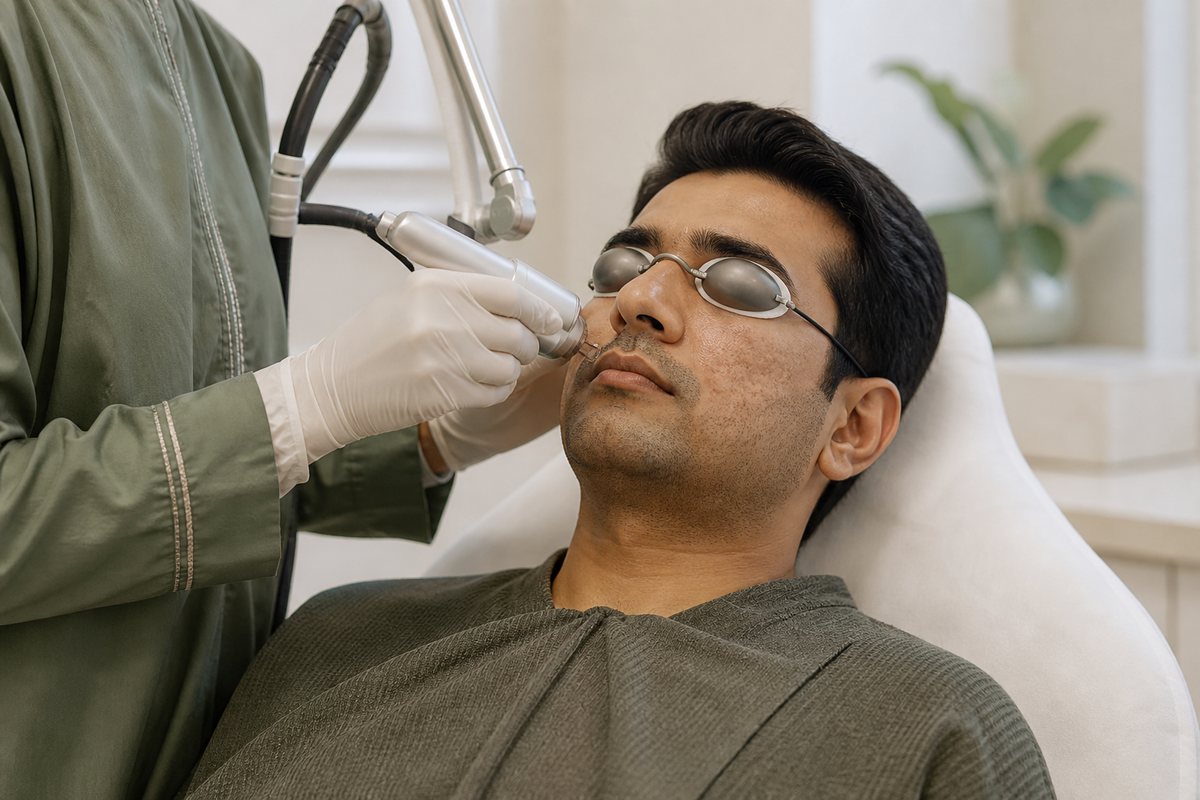
Fractional carbon-dioxide laser creates columns of controlled thermal injury to resurface skin and stimulate remodelling. It can be useful for selected scars and texture but has meaningful downtime and pigment risk, particularly in darker skin.
Treatment explained
Ablative fractional CO2 energy vaporises microscopic columns while leaving intervening skin to support healing. Density, energy, passes and treatment area determine depth and recovery. Device availability must be confirmed.
Problems and conditions
Possible suitability
Safety screening
This list is not exhaustive. The treating clinician must confirm contraindications and any condition-specific precautions.
Individual assessment
Assessment covers scar type, skin tone, pigment history, cold sores, medicines, prior isotretinoin or resurfacing, smoking and downtime. A test area or a less aggressive method may be preferable.
Step-by-step overview
Treatment often takes 30–90 minutes plus numbing time. Larger areas or deeper settings take longer.
Topical anaesthetic is common; injected local anaesthetic, nerve blocks or additional pain control may be needed for deeper treatment.
The exact technique, setting and anaesthetic plan require confirmation from the treating clinician after examination.
Downtime and healing
Gentle wound care is important.
Makeup waits until the surface has healed.
Collagen remodelling and colour change require follow-up.
Texture may improve progressively over several months. Deep ice-pick or tethered scars often need focal treatment or subcision; one laser session does not erase all scars.
Recovery and result timing are general ranges, not guarantees. Your written instructions and review findings take priority.
Potential benefits
Informed consent
Before treatment
After treatment
Why choose Dr Husnain Aesthetic Clinic?
Care is led by Assoc. Prof. Dr Husnain Khan, MBBS, MCPS, FCPS, MRCS. He has more than 17 years of experience as a plastic surgeon, is Head of the Department of Plastic Surgery at Holy Family Hospital, Rawalpindi, has worked in the UK NHS and is listed with GMC reference 7427786.
These credentials do not guarantee an outcome. The purpose of consultation is to decide whether treatment is reasonable for you and explain alternatives, limitations and follow-up.
Personalised quotation
A responsible quotation follows consultation because price depends on the treatment plan rather than the page name alone. Relevant factors include:
The published rate-list value is not a guaranteed final quotation. Ask what the written quotation includes and whether future sessions, tests, medicines or follow-up are separate.
Read the treatment-cost planning guide →Patient questions
No. It can soften selected scars, but complete removal should not be promised.
Visible wound healing commonly takes about one to two weeks; redness or pigment change can last longer.
It may be used selectively, but darker skin has a greater pigment risk and may need conservative settings or another method.
This depends on scar type, treatment intensity, response and risk tolerance.
No. CO2 is ablative; it removes microscopic skin columns and generally has more downtime than non-ablative treatment.
Combination may be useful for tethered scars but should be staged or planned carefully.
Direct sun should be avoided during healing, and diligent protection continues for months because pigment risk persists.
Increasing pain, spreading redness, pus, fever, eye symptoms, blisters or delayed healing require prompt contact.
Independent patient information
These external resources support further reading. They do not replace advice from the clinician responsible for your care.
Request a private appointment in Rawalpindi. Patients from Islamabad, elsewhere in Pakistan and overseas can ask what information is needed before travelling.
General patient information · Last reviewed 12 September 2026 · This page does not replace an examination, diagnosis or informed-consent discussion.